How to Budget for Annual Expenses Without Surprises
An annual bill is easy to miss in a budget that only looks at a normal month. Insurance renewals, memberships and planned gifts may be predictable even when they are not monthly. Instead of treating each one as an emergency, give it an amount, a due date and a place in your spending plan. The useful question is how many contributions you can make before the payment is due.
Make a list of bills that your monthly view misses
Review a full year of transactions and upcoming renewal notices. Look for annual insurance, memberships, yearly subscriptions, seasonal gifts and other planned costs. Record the expected amount and the payment date. Keep an estimate clearly labelled when you do not yet have the renewal price.
Separate known future bills from genuinely unexpected costs. A renewal you can anticipate belongs in this plan; an emergency reserve serves a different purpose. Looking beyond the last month also helps avoid overlooking infrequent spending, as the CFPB's spending review explains.
Work backwards from the due date
Subtract the money already reserved for the bill from the expected cost. Divide what remains by the number of contributions you can make before the payment date. Count the actual opportunities to put money aside: a contribution scheduled after the bill is due cannot help pay it.
For example, an expected €600 insurance bill with €150 already reserved and three monthly contributions remaining needs €150 per contribution: (€600 − €150) ÷ 3. Dividing the full bill by twelve would suggest €50 a month, which is too little for this starting position.
This table uses separate illustrative bills. Each row has its own due date; the monthly contribution column describes the current plan, not a fixed amount to keep saving forever.
| Expense | Expected cost | Already reserved | Monthly contributions left | Reserve each month |
|---|---|---|---|---|
| Annual insurance | €600 | €150 | 3 | €150 |
| Yearly membership | €180 | €0 | 6 | €30 |
| Planned gifts | €240 | €60 | 3 | €60 |
| Annual device cover | €120 | €0 | 6 | €20 |
| Total balance | €260 |
The current monthly contributions total €260. After the first three contributions, the insurance reserve reaches €600 and the gifts reserve reaches €240. The membership and device-cover reserves hold €90 and €60, so each needs three more contributions of €30 and €20 respectively.
The €210 shown as already reserved must be real cash you can keep for these bills. If a payment is due before you can contribute, the calculation exposes an immediate funding gap; dividing by zero or moving the due date in your spreadsheet does not solve it.
Give reserved money a clear purpose
A bank balance does not show which euros belong to future bills. Track a separate amount for each expense, whether in budget categories, a spreadsheet or bank savings pots. This is often called a sinking fund: money built up for a planned cost.
A dedicated savings account can help you keep the cash separate, but it is not essential. What matters is that the same money is not promised to two different bills. A transfer between accounts you own changes where the cash is held; it does not pay the insurance company.
Carry the category balance forward in Talvo
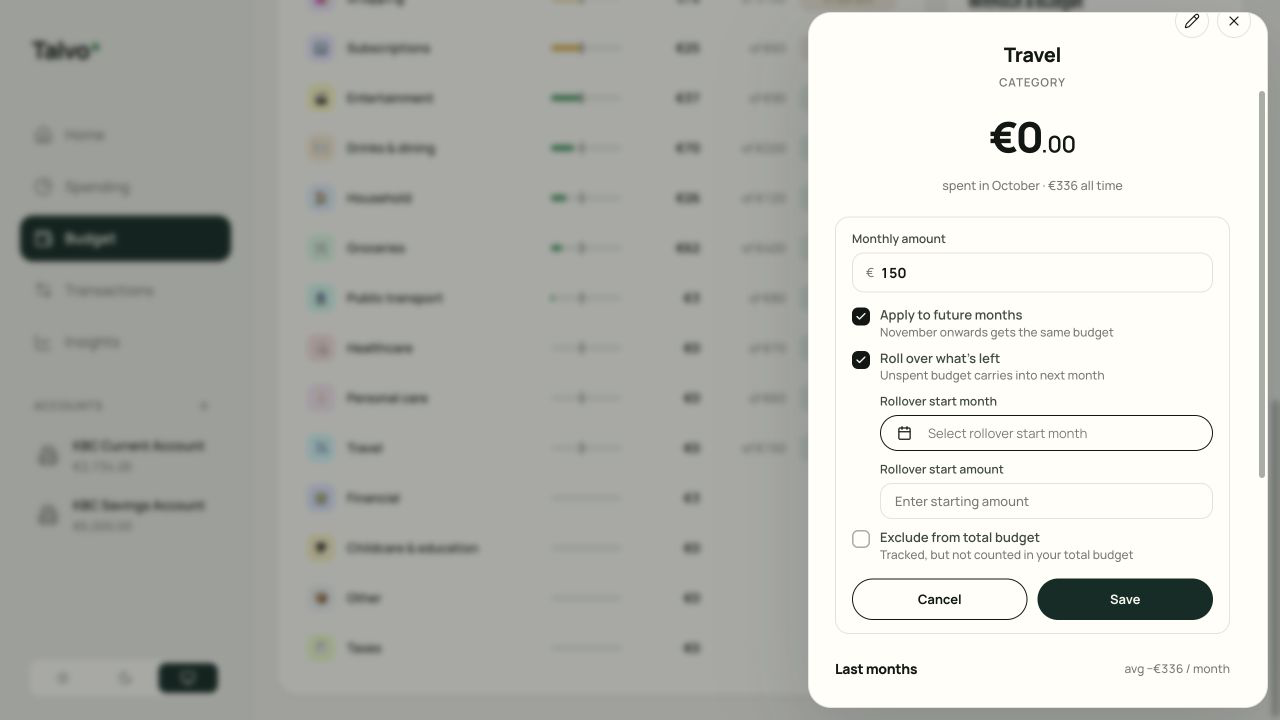
A monthly category that resets can hide progress toward a bill due later. Talvo lets a budget category carry unused money into the next month. In the category's budget settings, you can choose a start month and starting amount as well as enable rollover. The budget guide explains the controls.
Match any starting amount to cash you have actually reserved. Entering €150 as a category's starting amount does not create €150 in your bank. Continue adding the planned monthly amount, and check both the category balance and the account holding the cash.
Recalculate when the amount or timing changes
A renewal quote can be higher than last year's bill. Suppose the insurance price changes from €600 to €660 after you have reserved €450, with one contribution left. You now need €210, rather than €150. Review the rest of the plan before assigning that additional €60.
With irregular income, contributions do not have to be identical every month. A stronger month can fund more of a coming bill, but your reserved balance and the remaining cost still need to agree. If the plan is unaffordable, review the expense or contact the provider about available payment arrangements; a smaller budget number does not reduce the bill.
Set a calendar reminder ahead of the renewal so you can check the quote and any cancellation terms before committing. Recalculate from the actual payment date when a provider changes its schedule.
Record the bill once, then prepare for the next renewal
When you pay the bill, record the actual expense in its category. If you first move cash from savings to your current account, keep that movement as a transfer. Otherwise you can make one annual bill appear as two expenses.
Once an expected €600 bill is paid, you could prepare for the next one with €50 each month if there are twelve contributions before it is due again and you start with nothing reserved. Recalculate if the amount, timing or remaining reserve differs. Planned gifts and cancelled memberships may need a new target rather than automatic repetition.
Begin with the next three known bills
For each one, record the expected cost, the cash already reserved and the number of contributions left. Calculate the contribution, add it to your plan and put the due date in your calendar. A useful annual-expense budget makes future bills visible today, without pretending every month costs the same.